
 Español

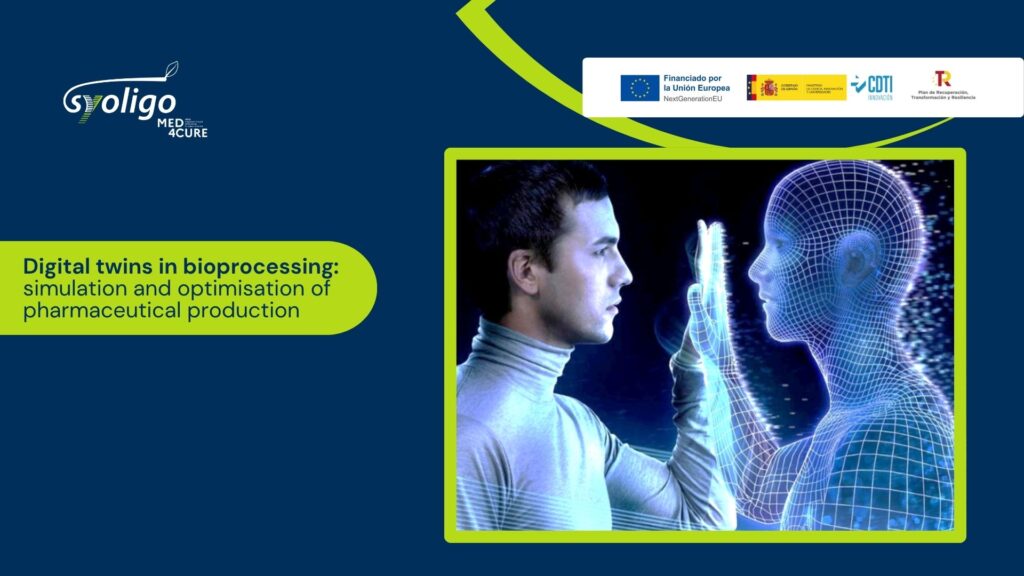
The growing complexity of bioprocesses in the pharmaceutical industry, particularly in the development of innovative therapies such as oligonucleotides, is accelerating the adoption of digital technologies capable of improving understanding, control and production efficiency. In this context, digital twins have established themselves as one of the most promising tools within the industry’s paradigm as applied to biomanufacturing. A digital twin can be understood as a dynamic virtual representation of a physical process that integrates real-time data, mechanistic models and data-driven approaches to simulate, monitor and predict the behaviour of the production system. This ability to replicate the process in a digital environment allows us not only to observe what is happening, but also to anticipate how it will evolve under different operating conditions, facilitating more informed and proactive decision-making.
In the field of bioprocessing, these systems combine first-principles models, statistical models and machine learning algorithms that are continuously updated using data from sensors, manufacturing execution systems and process analytics technologies. This integration makes the digital twin a key tool for improving process understanding and enabling predictive control strategies, as it allows multiple scenarios to be simulated without the need for direct intervention in the physical system. The evolution of these technologies is closely linked to advances in artificial intelligence, high-performance computing and the Internet of Things, which allow for the incorporation of a greater number of variables and a more accurate representation of the complexity of biopharmaceutical systems.
One of the key impacts of digital twins on pharmaceutical manufacturing is their ability to optimise processes throughout the entire product lifecycle. By simulating operating conditions, it is possible to identify optimal configurations that maximise yield and minimise variability, thereby reducing the need for intensive empirical experimentation. This approach is particularly relevant in complex processes, where small variations in parameters such as temperature, pH or concentrations can significantly affect the quality of the final product. Furthermore, the use of digital twins enables the implementation of advanced control strategies based on predictive models, facilitating the early detection of deviations and the automatic correction of operating conditions before process failures occur.
The integration of these tools with regulatory frameworks such as Quality by Design (QbD) and technologies such as Process Analytical Technology (PAT) reinforces their role in improving process quality and robustness. QbD promotes the design of processes that ensure product quality from the outset, whilst PAT enables real-time monitoring of critical attributes. Together, these approaches, supported by digital twins, enable a transition towards more efficient, sustainable and knowledge-based manufacturing systems (Ding et al., 2024).
In the case of oligonucleotide synthesis, where molecular precision and impurity control are critical, the use of digital models and advanced monitoring tools takes on particular importance. PAT technologies are already used for real-time monitoring of chemical reactions and purification stages, facilitating the modelling of processes such as tangential flow filtration or molecular conjugation. The incorporation of digital twins in this context enables this data to be integrated into more comprehensive predictive models, optimising both synthesis and downstream stages and improving batch-to-batch reproducibility (Ding et al., 2024).
Another critical aspect is the scaling up of processes from the laboratory to industrial production, one of the main challenges in biomanufacturing. Digital twins enable the simulation of operating conditions at different scales, the identification of limitations associated with mass or heat transfer, and the anticipation of potential deviations prior to physical implementation. This capability significantly reduces the risk associated with technology transfer and helps to shorten development times. Furthermore, their use facilitates regulatory compliance by providing detailed process knowledge and complete data traceability, key elements in GMP environments.
Despite their potential, the implementation of digital twins in bioprocesses presents significant challenges, including the need for high-quality data, the validation of models in regulated environments, and integration with existing digital infrastructures. The lack of standardisation and the complexity of biological systems add further layers of difficulty, which explains why their adoption has not yet become widespread across the industry. However, the trend towards digitalisation is clear, and investment in digital technologies is expected to continue growing significantly in the coming years, driving a profound transformation in the way pharmaceutical processes are designed, operated and optimised.
In this context, digital twins represent not only a tool for optimisation, but a paradigm shift towards smarter, more connected and more predictive pharmaceutical manufacturing. Their ability to integrate data, models and process knowledge positions them as a key element in the development of advanced therapies, where precision and reproducibility are essential. In areas such as oligonucleotide-based therapies, this approach can make a significant contribution to improving development efficiency, ensuring product quality and accelerating the delivery of new therapeutic solutions to patients.
Sources:
Aslam, J., Khan, S., Siddiqui, Z., Fatima, Z., & Maqsood, M. (2025).
Bioprocess digital twins: Enabling data-driven biomanufacturing.
Open Access Journals. https://www.openaccessjournals.com/articles/bioprocess-digital-twins-enabling-datadriven-biomanufacturing-18626.html
Canzoneri, M., Horner, M., & Banerjee, P. (2024).
Digital twins in biomanufacturing. In Nemat (Ed.), Bioconvergence Revolution. Springer.
https://link.springer.com/content/pdf/10.1007/978-3-031-61593-1_4
Ding, C., Yang, O., & Ierapetritou, M. G. (2024). Towards digital twin for biopharmaceutical processes: Concept and progress. En M. G. Ierapetritou & C. S. Brazel (Eds.), Digital twins in chemical engineering: Concepts and applications (pp. 129–157). Springer.
https://link.springer.com/chapter/10.1007/978-3-031-45669-5_6
Riezzo, L., Kay, H., Feng, Y., Jing, K., & Zhang, D. (2025).
Accelerating bioprocess digital twin development by integrating hybrid modelling with transfer learning. Chemical Engineering Journal.
https://doi.org/10.1016/j.cej.2025.162018
Strube, J., et al. (2020).
Digital twins in biomanufacturing. PubMed.
https://pubmed.ncbi.nlm.nih.gov/33346865/

