
 Español
Brussels, May 28, 2024
The European Commission has approved, under EU state aid rules, a fourth major project of common European interest (IPCEI) to support research, innovation and first industrial deployment of medical devices, as well as innovative production processes in the pharmaceutical sector. This IPCEI will contribute above all to the objectives of the European Health Union by providing innovations against diseases for which there are no satisfactory means of prevention or treatment and by increasing the EU’s preparedness against emerging health threats.
The project, called “PIICE Med4Cure“, was prepared and notified jointly by six Member States (Belgium, Slovakia, Spain, France, Hungary and Italy).
Member States will provide up to EUR 1 billion in public funding, which is expected to unlock an additional EUR 5.9 billion in private investment. As part of this IPCEI, thirteen companies with activities in one or more Member States, including nine small and medium-sized enterprises (SMEs), will participate in fourteen innovative projects.
PIICE Med4Cure refers to research and development projects covering all key phases of the pharmaceutical value chain, from the collection and study of cells, tissues and other samples to sustainable production technologies for breakthrough therapies, including personalized treatments, and the application of advanced digital technologies.
The project aims to accelerate medical progress and foster the resilience of the EU healthcare industry by improving drug discovery, especially for unmet medical needs such as rare diseases, and developing innovative and more sustainable pharmaceutical production processes. These developments will improve the quality of healthcare and increase the EU’s preparedness for emerging health threats, while contributing to the ecological transition.
The PIICE is generally expected to be completed by 2036, with varying deadlines depending on the different projects and participating companies. According to the participating member states, around six thousand direct and indirect jobs are expected to be created.
Evaluation of the Commission
The Commission assessed the proposed project under EU state aid rules, more specifically its 2021 Communication on Important Projects of Common European Interest (“IPCEI Communication”). Where private initiatives supporting cutting-edge innovation fail to materialize due to the significant risks involved in such projects, the IPCEI rules allow Member States to jointly bridge this gap to overcome these significant market failures. At the same time, the IPCEI rules ensure that the EU economy as a whole benefits from the supported investments and that potential distortions of competition are limited.
The Commission has found that the Med4Cure IPCEI meets the required conditions set out in its Communication. In particular, the Commission has reached the following conclusions:
- PIICE Med4Cure contributes directly to the achievement of several EU objectives of a greener, safer and more resilient economy as well as more accessible healthcare set out in key EU policy initiatives such as the updated Industrial Strategy, the European Health Union including the Pharmaceutical Strategy for Europe and the European Plan to Combat Cancer, as well as the new European Research Area and the Green Pact.
- The fourteen projects that are part of the PIICEs are very ambitious, as they aim to develop technologies that go beyond what is currently offered on the market and will enable significant improvements, especially in the fields of diagnostic solutions and the treatment of rare diseases, antimicrobial resistance and cancers.
- The IPCEI also involves significant technological and financial risks. Therefore, public aid is necessary to provide incentives for companies to make investments.
- Aid to individual companies is limited to what is necessary and proportionate and does not unduly distort competition. In particular, the Commission has verified that the maximum amounts of total planned aid are in line with the eligible costs of the projects and their financing gaps. Moreover, if large projects covered by the IPCEI prove to be highly successful and generate additional net revenue, the companies will repay part of the aid received to the Member States concerned(repayment mechanism).
- Participating companies will share the results of the project widely with the European scientific community and industry beyond the companies and member states that are part of the IPCEI, namely through conferences, publications, access to pilot and production facilities or licensing of intellectual property rights. As a result, positive spill-over effects will be generated throughout Europe.
On this basis, the Commission has concluded that the project is in line with EU state aid rules.
Financing, participants and structure of the IPCEIs
The PIICE covers fourteen projects from thirteen companies. These projects will result in more than seventy planned collaborations.
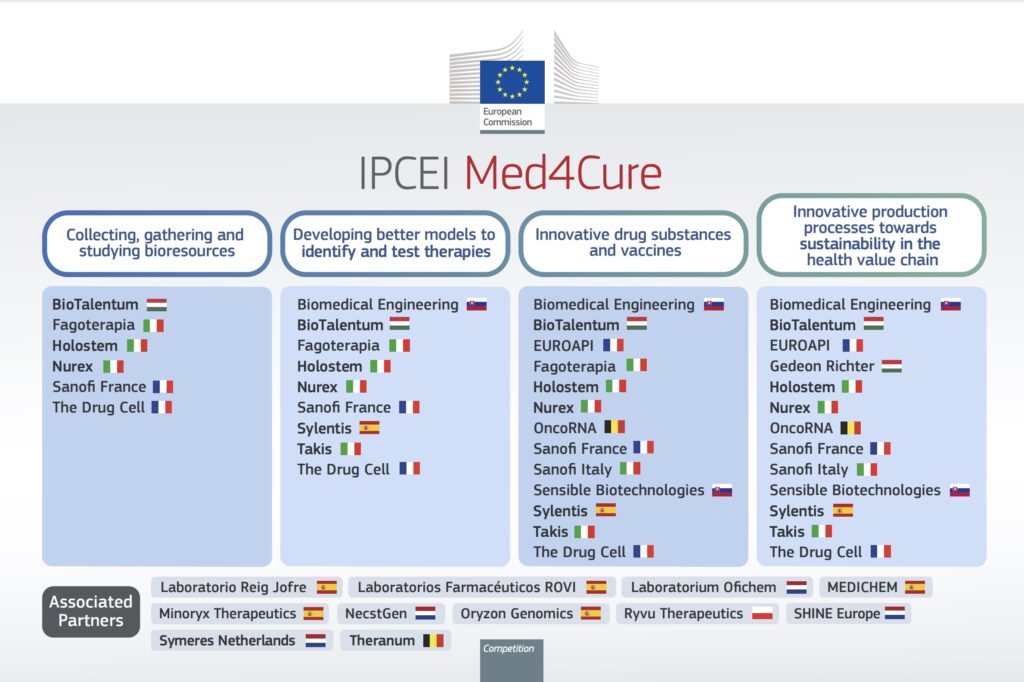
The graph below shows the general structure of the PIICE Med4Cure, including its various lines of work:
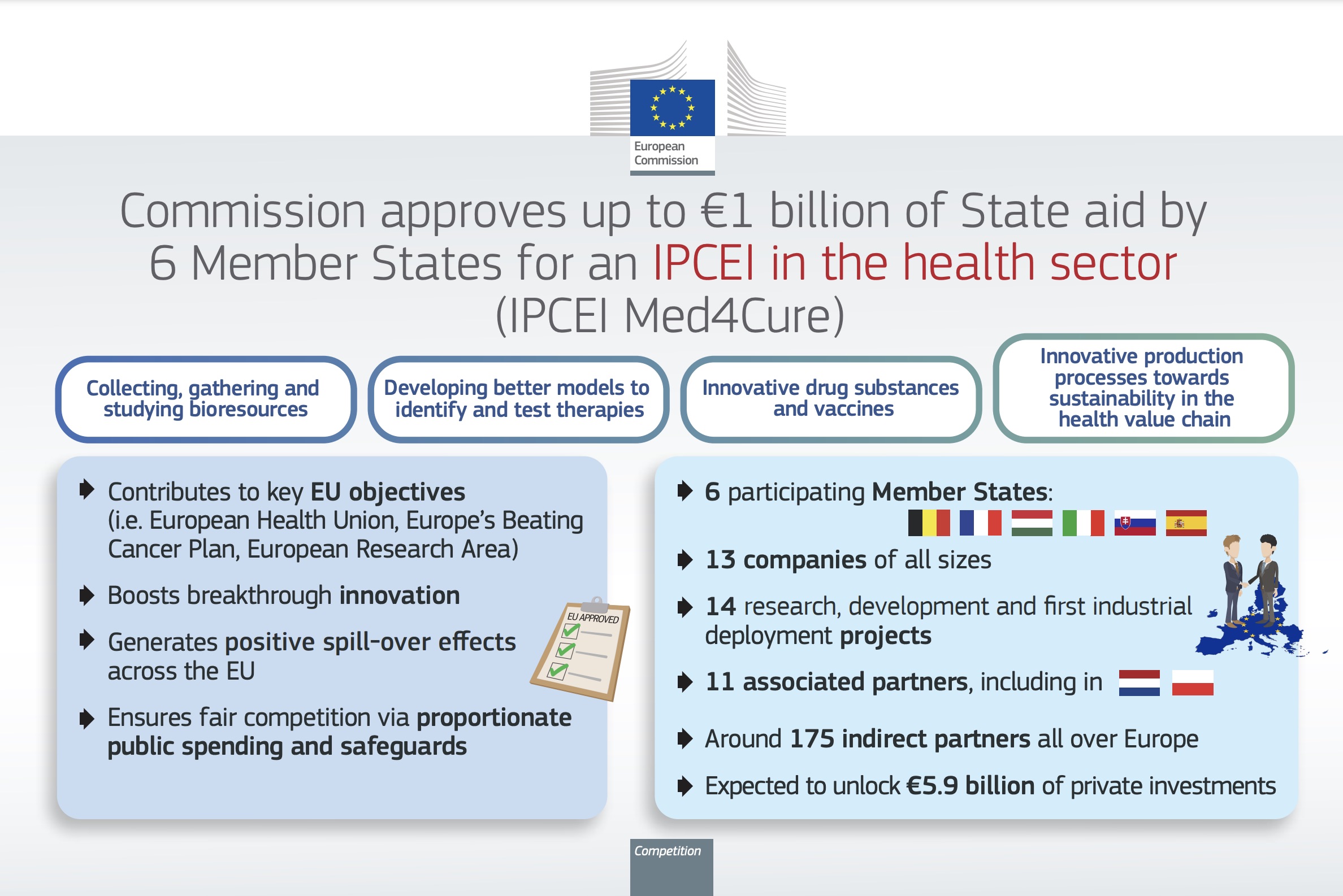
The fourteen projects are part of the wider PIICE Med4Cure ecosystem, which also involves eleven associate members in four Member States (Belgium, Spain, the Netherlands and Poland).
In addition, there are about 175 indirect partners, which are companies or research organizations that will benefit from the various dissemination activities of PIICE Med4Cure.
The chart below presents the overall structure of PIICE Med4Cure and its wider ecosystem, including its various work streams:
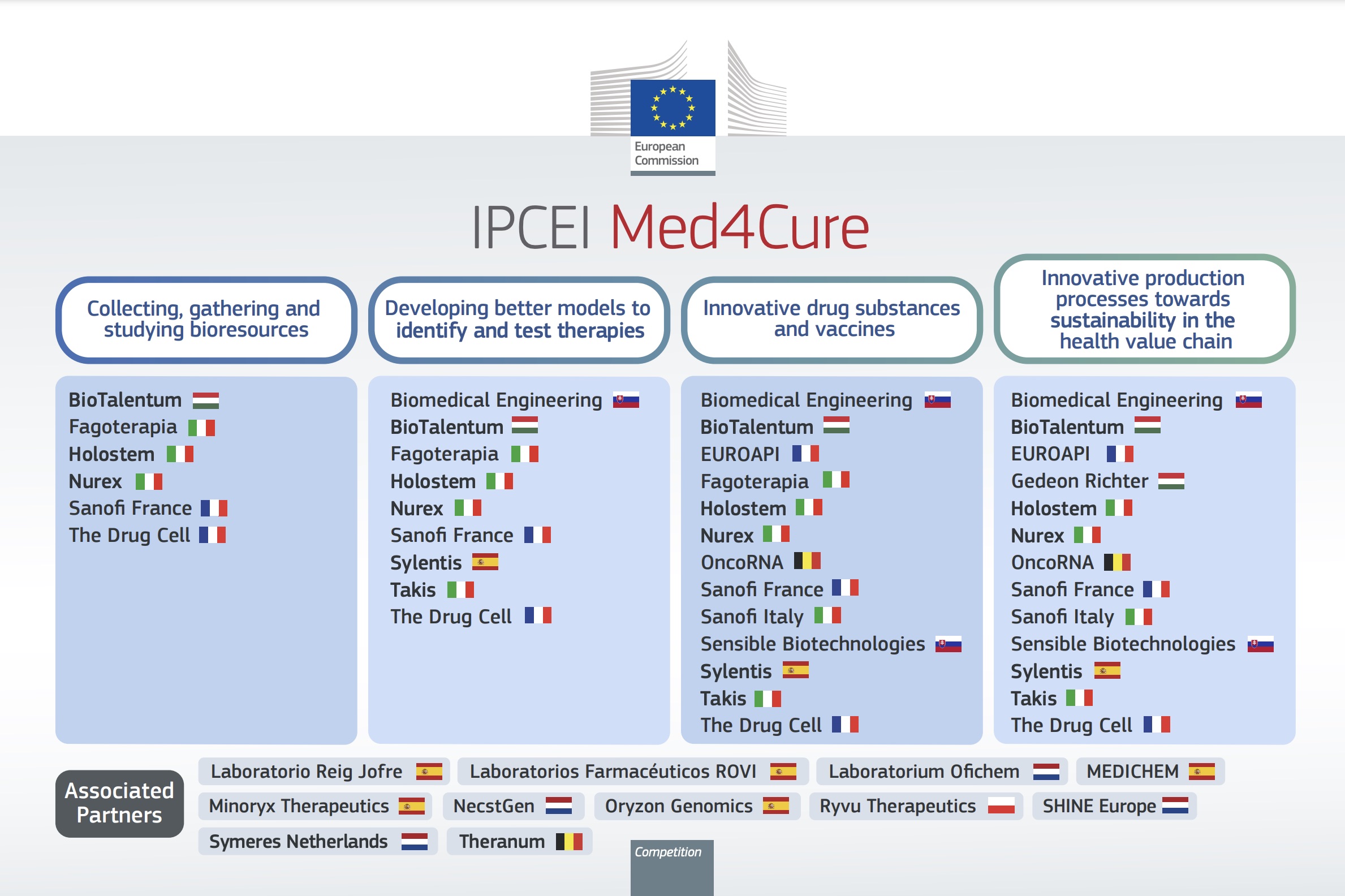
Spain has included its participation in the PIICE Med4Cure in its recovery and resilience plan and can therefore partially finance its projects under the Recovery and Resilience Mechanism.
Further information on the amount of aid received by each of the participants will be included in the public version of the Commission’s decision once the Commission has agreed with the Member States and third parties on confidentiality issues.
Context
In March 2022, sixteen Member States signed a joint Manifesto for a Health IPCEI, declaring their support for an IPCEI relating to innovation in drug production technologies, the fight against antimicrobial resistance, rare diseases and emerging health threats, and the development of cell and gene therapies.
In addition to the Med4Cure IPCEI, the Commission today approvedalso the Hy2Move IPCEI. The Commission decisions concern the ninth and tenth integrated IPCEIs approved under EU state aid rules. They are approved on the basis of the 2021 IPCEI Communication, which sets out the criteria under which several Member States may support transnational projects of strategic importance for the EU under Article 107(3)(b) of the Treaty on the Functioning of the European Union. The Communication aims to encourage Member States to support highly innovative projects that clearly contribute to economic growth, employment and competitiveness.
The IPPC Communication complements other state aid rules, such as the General Block Exemption Regulation and the Framework for State Aid for Research and Development and Innovation, in supporting innovative and environmentally friendly projects, while ensuring that potential distortions of competition are limited.
As part of an effort to support a transparent, inclusive and faster design of IPCEIs, the Commission published on May 17, 2023 a code of good practice on DG Competition’s dedicated IPCEI website. In addition, the Commission has set up the Joint European Forum for Major Projects of Common European Interest (JEF-IPCEI). The purpose of the forum is to identify areas of strategic EU interest for possible future IPCEIs and to increase the efficiency of the IPCEI process. The JEF-IPCEIP brings together experts from the Member States and the Commission services, and representatives from industry, academia and other interested parties, as appropriate.
To further streamline and simplify the deployment of IPCEIs, the Commission introduced on June 23, 2023 an amendment to the General Block Exemption Regulation (GBER) whereby R&D projects related to multi-country projects such as IPCEIs can receive grants of up to €50 million without the need for notification to the Commission. At the same time, these projects continue to be recognized as part of the ecosystem created by an IPCEI.
Non-confidential versions of decisions will be published under case numbers SA.105088 (Belgium), SA.105097 (Slovakia), SA.105098 (Spain), SA.104974 (France), SA.105126 (Hungary) and SA.105085 (Italy), and in the State Aid Register on the competition website once confidentiality issues have been resolved. New publications of state aid decisions on the Internet and in the Official Journal are listed in the weekly online state aid news.

