
 Español

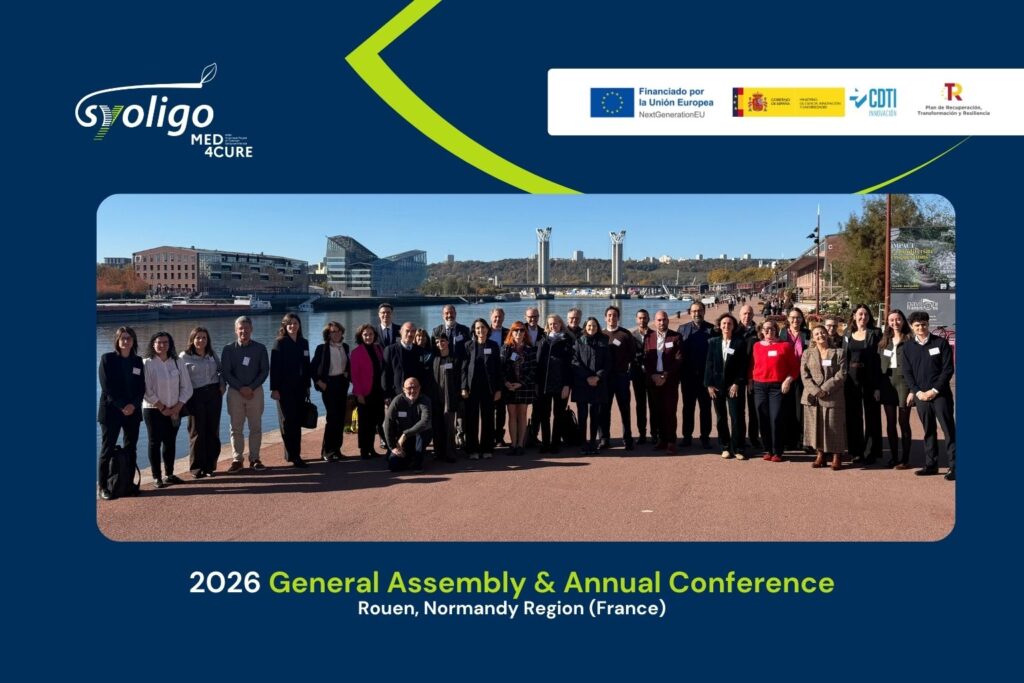
On 30 October 2026, Sylentis attended the IPCEI Health Med4Cure General Assembly, held at the Pavillon des Transitions in Rouen, France. The event addressed the progress of the projects, governance and monitoring mechanisms, scientific collaboration and the factors influencing the transfer of pharmaceutical innovation to the industrial sector.
Sylentis’s involvement enabled the Syoligo project to be placed within the context of the shared progress and priorities within Med4Cure. The programme comprised a number of sessions on institutional coordination and project implementation, and concluded with a visit to the research facilities at the Institut CARMeN and an overview of its collaboration with the pharmaceutical industry.
Launch and review of progress on Med4Cure
Following the registration and accreditation of the participants, the event began with a welcome address from the Directorate-General for Enterprise (DGE) of the French Ministry of Industry and the Economy, followed by the presentation of the programme.
The first working session focused on the progress made since the previous General Assembly. The main developments in governance, project development and partnerships were reviewed, as were the next steps for the initiative. In addition, the European Commission (DG COMP) gave a presentation during this session on the annual report.
This monitoring makes it possible to link the progress of individual projects to Med4Cure’s collective objectives. In pharmaceutical development programmes, coordination between organisations is particularly important where there are interdependencies between research activities, process development, analytical characterisation and the preparation for technology transfer.
The conference included a session on the institutional and financial conditions that accompany technological development. On this topic, the European Investment Bank spoke about the financing of innovation in healthcare and its industrialisation.
These issues are directly linked to the transition from research to manufacturing. The viability of a pharmaceutical technology depends not only on its experimental performance, but also on the availability of facilities, equipment, analytical capabilities and resources to establish reproducible operations.
General Assembly: governance, monitoring and working groups
The day continued with two parallel sessions.
The session of theMed4Cure General Assemblyincluded the Facilitation Group’s report, governance amendments and votes, the presentation of annual reports and a review of the working groups’ progress. It also addressed collaborations and the dissemination and transfer of knowledge generated by the initiative, known asspillovers.
Governance and monitoring provide the necessary framework for defining responsibilities, documenting progress and coordinating activities amongst participants. From a technical perspective, these mechanisms help to identify dependencies, review deviations and adjust the planning of tasks that require input from various organisations.
Side event for national coordinators
At the same time, the programme included themeeting of Med4Cure national coordinators, featuring a round of contributions from Member States.
This session focused on the national implementation and monitoring of projects, reporting requirements, European governance and dialogue with the European Commission.
The fact that it was held in parallel with the General Assembly reflected the different levels of coordination within the initiative. Whilst the Assembly session addressed governance and joint activities, the coordinators’ meeting focused on the link between national monitoring and the European implementation framework.
Discussion and get-together amongst participants
The morning session concluded with a joint closing session, followed by a working lunch at the Pavillon des Transitions.
This session was designed to facilitate discussion amongst participants and to continue conversations about projects, capabilities and potential areas of collaboration.
In pharmaceutical development initiatives, these exchanges facilitate the identification of complementary expertise and infrastructure. Their technical value lies in linking specific development needs with the capabilities required to investigate them: from the study of a reaction step to the characterisation of complex mixtures or the evaluation of processing alternatives.
The afternoon session took place at the Institut CARMeN in Mont-Saint-Aignan.
An integrated approach to the development of Syoligo
Sylentis’s participation in the General Assembly in Rouen provided an opportunity to link the Syoligo project with Med4Cure’s priorities regarding implementation, collaboration and industrialisation. Tamara Martínez took part, sharing the progress and achievements made to date, which have been supported by €21.1 million in funding from the CDTI – Ministry of Science and Innovation – using NextGeneration funds from the European Union.
The conference brought together aspects closely linked to the development of pharmaceutical technologies: coordination of projects, access to specialised scientific expertise, transfer of knowledge and preparation for industrial implementation.

