
 Español
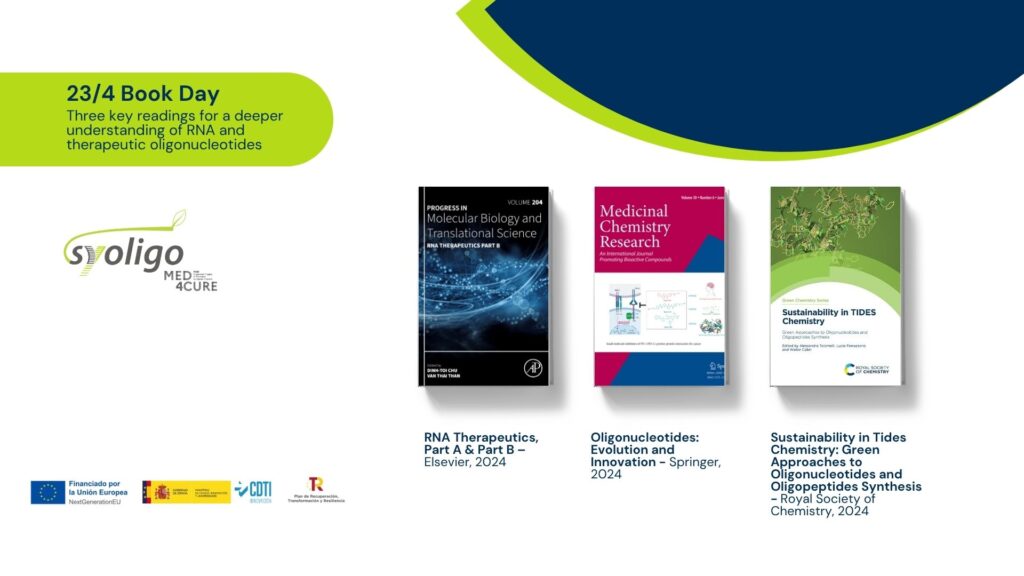
Every 23 April, World Book Day invites us to reflect on the value of knowledge as a driving force for progress. In the field of biomedicine, the generation and transfer of knowledge are essential for driving innovation, particularly in areas such as RNA- and oligonucleotide-based therapies, which are redefining the approach to treating a wide range of conditions.
Beyond the primary scientific literature, there are reference works that help to contextualise these advances, understand the underlying molecular principles and explore emerging clinical applications. In this context, we present three readings that address RNA and oligonucleotides from complementary perspectives: molecular fundamentals, therapeutic development and an overview of their impact on modern biotechnology.
RNA-based therapies: translational development and clinical applications
RNA Therapeutics – Part A & Part B (Elsevier, 2024)
RNA-based therapies have established themselves as one of the most promising platforms in precision medicine, with applications ranging from rare diseases to oncological, metabolic, and viral pathologies. This two-volume work provides a comprehensive and up-to-date overview of the field, addressing the development of these therapies from a distinctly translational perspective.
One of the key aspects examined is the diversity of RNA-based therapeutic modalities, including mRNA, siRNA, antisense oligonucleotides (ASOs) and guide RNA in CRISPR systems, each with specific mechanisms of action aimed at modulating gene expression. The work delves into the design principles of these molecules, taking into account factors such as structural stability, target specificity and the optimisation of biological activity.
The report also examines in detail the challenges associated with the efficient delivery of these molecules to target tissues, one of the main bottlenecks in their development. In this regard, it analyses various delivery strategies, such as lipid nanoparticles (LNPs), chemical conjugates (e.g. GalNAc) and vector-based systems, assessing their advantages, limitations and clinical applications.
From a clinical perspective, the book reviews recent advances in the application of these therapies to rare diseases, where oligonucleotides and therapeutic RNA have demonstrated significant potential due to their ability to target specific sites. It also examines regulatory and clinical development aspects, including trial design, safety assessment and the management of risks associated with immunogenicity and off-target effects.
Taken as a whole, these volumes provide an up-to-date overview of the entire process a10> which ranges from molecular design to clinical application, highlighting the growing maturity of this field and its impact on medicine today.
Therapeutic oligonucleotides: technological innovation and industrial scaling
Oligonucleotides: Evolution and Innovation (Springer, 2024)
The development of therapeutic oligonucleotides requires close integration between molecular biology, medicinal chemistry and process engineering. This book focuses on the technological evolution of the field, analysing the latest advances in synthesis, chemical modification and industrial-scale production.
From a chemical perspective, the book explores strategies for the structural modification of oligonucleotides, aimed at improving key properties such as stability against nucleases, binding affinity to the target RNA, and bioavailability. These modifications include changes to the phosphate backbone, sugars and nitrogenous bases, resulting in a wide variety of molecular architectures with specific therapeutic applications.
In the field of production, the book addresses the challenges associated with solid-phase synthesis, one of the most widely used technologies for the manufacture of oligonucleotides. It analyses bottlenecks in processes such as nucleotide coupling, reaction efficiency, purification and scale-up – critical aspects for ensuring the quality of the final product.
The report also examines the requirements for transitioning from research environments to production under GMP (Good Manufacturing Practices) conditions, where factors such as reproducibility, impurity control, traceability and process validation play a central role.
Another of the key elements addressed by the work is the integration of these processes into chains of pharmaceutical supply chains, where the capacity to scale up production in a manner efficient and robust is essential to meet demand in clinical settings.
This approach is particularly relevant in the context of projects such as SYOLIGO, where the optimisation of production processes and technology transfer are key to the development of advanced therapies.
Sustainable production of oligonucleotides: green chemistry and process efficiency
Sustainability in Tides Chemistry: Green Approaches to Oligonucleotides and Oligopeptides Synthesis (Royal Society of Chemistry, 2024)
The growing demand for oligonucleotide-based therapies presents not only technological challenges but also challenges relating to the sustainability of production processes. Against this backdrop, recent publications by the Royal Society of Chemistry provide an up-to-date overview of the application of green chemistry principles in the manufacture of these compounds.
One of the key issues addressed is the reduction of the environmental impact associated with oligonucleotide synthesis, a process that traditionally involves the intensive use of organic solvents and chemical reagents. Strategies aimed at minimising resource consumption, improving reaction efficiency and reducing waste generation are analysed.
These strategies include:
- Optimising synthetic routes to reduce the number of steps and improve overall performance
- The development of new reagents and less harsh reaction conditions
- Replacing solvents with more sustainable alternatives
- The implementation of continuous processes versus batch processes
Furthermore, the focus is on assessing environmental impact throughout the entire product life cycle, incorporating analytical tools such as Life Cycle Assessment (LCA), which are essential for decision-making in industrial settings.
These approaches are in line with the growing integration of ESG (Environmental, Social and Governance) criteria within the pharmaceutical industry, where sustainability is becoming established as a key factor in the development and production of medicines.
In this context, the specialist literature plays a key role as a bridge between fundamental knowledge and its clinical application. A combination of approaches—ranging from molecular analysis to a translational perspective—is essential for driving the development of innovative therapeutic solutions.
On World Book Day, these readings offer an opportunity to delve deeper into a constantly evolving field, where knowledge is not only generated but also translates into a real impact on patients’ health and quality of life.

